Part one
Phrases first, grammar close behind.
Beginners speak in chunks long before they command grammar. So lesson one hands you whole, frozen phrases like ég heiti, “my name is”, and lets you use them before anyone explains what each word is doing in there. The rule shows up afterwards, once you already have examples in your head to hang it on.
The grammar is still coming, and it is coming in full. Just not on page one, where it would only be a list to memorise.
Part two
Grammar you can see and touch.
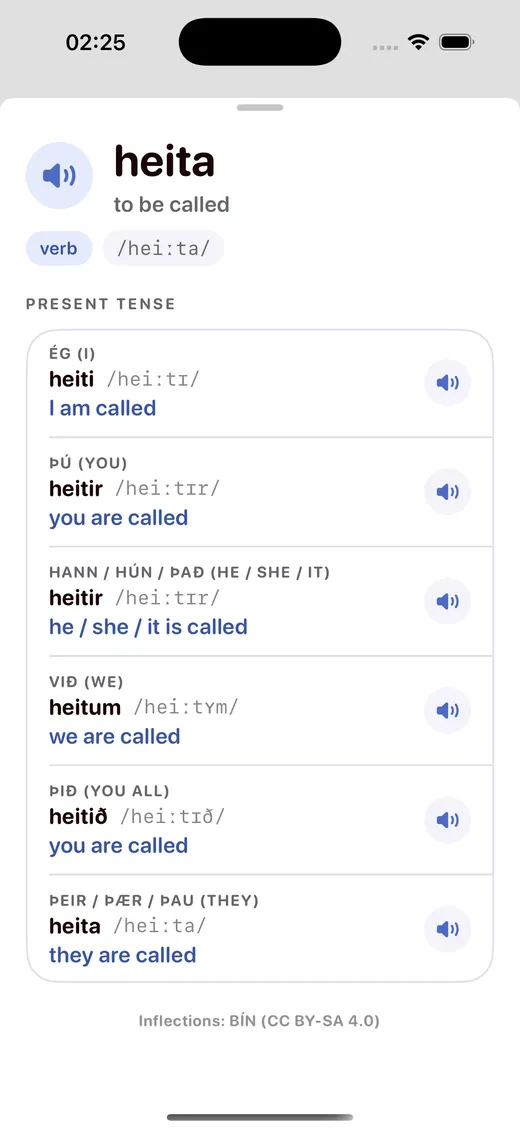
Tap any word and you get its complete official inflection table: every case, every number, the definite forms too, with audio on every single line. The whole shape of the word is right there.
The payoff comes when you put the right Icelandic form in the wrong slot. Type Ég sé hundurinn and the app doesn’t just mark it wrong: hundurinn is the nominative, the form every table starts with. The dog is the object of the sentence, so it takes the accusative: hundinn. You get the explanation at the moment you need it.
The drills are generated from those same tables, so a review tests the rule with a word you haven’t seen in that slot before. You can’t pass by remembering last week’s answer. You pass by knowing the pattern.
Part three
Reviews timed to your memory.
Every word you meet is scheduled by a spaced-repetition algorithm that reads your review history: what you got right, what you hesitated over, how long ago. It brings each word back around the point where you’d otherwise start to lose it.
The scheduler is open source, so you can read how it decides. And everything the app shows you about your progress is read out of that same memory model.
Part four
Three-minute lessons that end on a win.
A lesson is roughly 15 exercises and takes about three minutes, short enough that doing one is never a decision you have to talk yourself into. The shape inside those three minutes matters as much as the length.
A session never opens with the hardest thing in it: recognition comes before recall, and production comes once the words are warm. It ends on something you are near-certain to get right, because the last thing that happens is the thing you remember about the session. And every unit finishes in a scene, a conversation you can have.
Part five
A language is for talking to people.
Every unit already points there: the scene closers are conversations you can have. The next step is having them with another learner. Conversation rooms, where learners speak Icelandic with each other inside the app, are where this is heading after launch.
Until then, the community shapes the app itself: feature requests, design feedback, ideas about where it should go.